
Root-Zone Heat Matters During Propagation
During seedling and cutting propagation, the most important temperature is often the one many growers are not actively controlling: media temperature. Mist, evaporative cooling, cold irrigation water, and cold benches can keep the root zone several degrees cooler than the air, slowing callusing and root initiation in cuttings and delaying germination and early root growth in seedlings. The result is longer propagation time, delayed crop turns, and more variability across benches.
For vegetative cuttings, controlled root-zone heating is one of the most reliable ways to promote callusing and root initiation. A common target is to maintain the propagation media at 72 to 75 F (22 to 24 C) while keeping air temperature about 5 to 10 F (3 to 6 C) cooler to limit shoot stretch and prioritize rooting. If root-zone heat is not available, air temperatures often need to be run higher (for example, 77 to 80 F [25 to 27 C]) to keep the media warm enough for timely rooting.
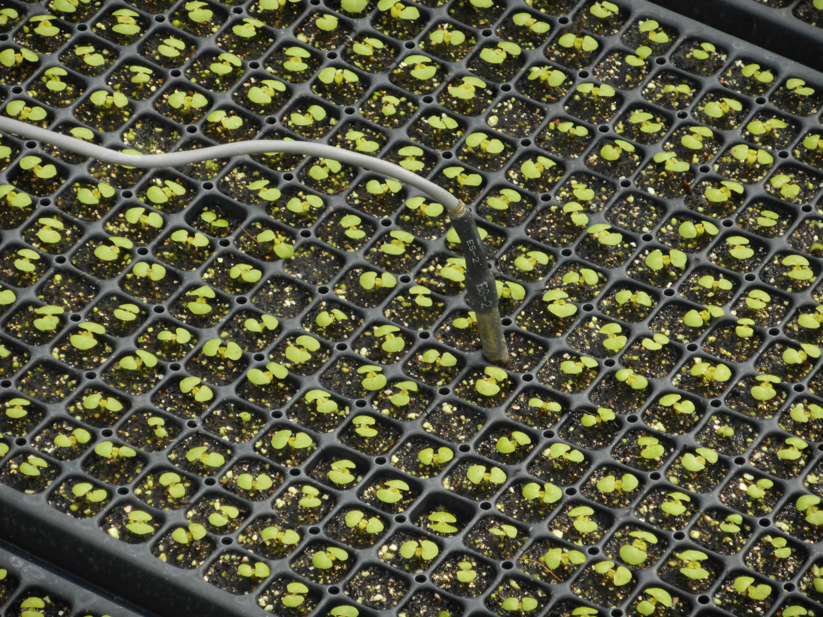
For seedlings and plugs, consistent media temperatures improve the speed and uniformity of germination and early root development, which sets up more uniform plug size later. As a general benchmark for many bedding plant species, aim for a media temperature of 72 to 75 F (22 to 24 C) during germination, then drop slightly to 70 to 72 F (21 to 22 C) after emergence to reduce stretch while maintaining root growth. Once plugs are established, begin toning by reducing or eliminating root-zone heating. Always confirm crop-specific targets with your seed supplier, since temperature optima vary widely by genus and cultivar.
To manage root-zone temperature effectively, monitor the media itself. Place sensors at rooting depth (not on the surface) and spot-check multiple locations because bench edges and low spots often run cooler and drive uneven rooting. Also, manage bottom heat as a staged setpoint rather than a constant. Once roots are visible and cuttings or seedlings begin taking up water, gradually reduce media temperature to improve tone so crops can be moved out of propagation on a more uniform schedule with strong, well-distributed root systems.
W. Garrett Owen
Assistant Professor of Sustainable Greenhouse and Nursery Systems, The Ohio State UniversityW. Garrett Owen is an Assistant Professor of Sustainable Greenhouse and Nursery Systems in the Department of Horticulture and Crop Science at The Ohio State University. He has an appointment in research, teaching and Extension. His area of expertise is plant nutrition; plant growth regulation; and production problem diagnostics.
