
Ammi majus and Queen Anne's Lace: Two Flower-Loving Caterpillars
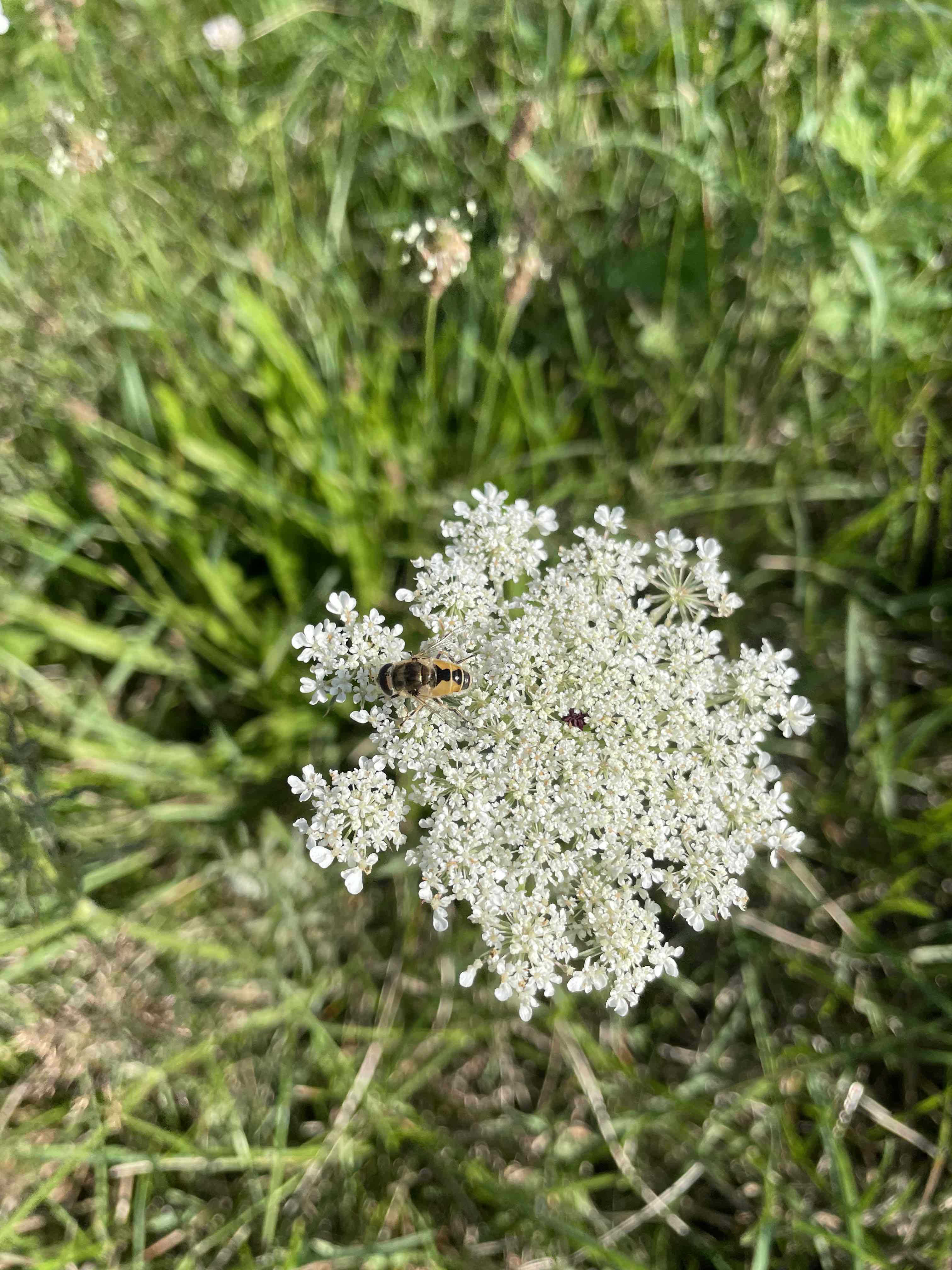
Among mid-summer's delights is the coordinated bloom along our roadsides of blue (rarely white or pink) chicory (Cichorium intybus) and Queen Anne's lace (Daucus carota). Both flowers and seed heads of the latter are gathered for bouquets and birds appreciate the seeds in fall and winter. Queen Anne's lace is also great for 'pollinator viewing,' particularly attractive to interesting beetles and flies. Some cultivars ('Dara,' 'Purple Kisses') are popular cultivated cut flowers and the related similar false Queen Anne's lace (Ammi majus) is also widely grown for cut flower production. I recently learned of two caterpillars that also appreciate these flowers, feeding in and webbing florets and seed heads, which can affect marketability. Purple carrot-seed moth (Depressaria depressana), native to western Asia and Europe, was first reported in North America from Ontario in 2008. Carrot seed moth (Sitochroa palealis) is known from Europe, northern Africa, parts of Asia and eastern Russia and first reported in North America from the US Midwest in 2002. Both have now spread widely throughout northeastern US and adjacent southern Canada. Hosts include some other related herbs and weeds. Photos of adult moths of both species can be seen at BugGuide (https://www.bugguide.net) and Moth Photographers Group (https://mothphotographersgroup.msstate.edu) websites; BugGuide includes images of the caterpillar stage as well.
For more information see Jeffrey Ogden's 2017 paper reviewing both in the Journal of the Acadian Entomological Society (https://www.acadianes.ca/journal/papers/ogden_17-7.pdf).
Dan Gilrein
Entomologist, Cornell Cooperative Extension of Suffolk CountyDan Gilrein is the Extension Entomologist with Cornell Cooperative Extension of Suffolk County at the Long Island Horticultural Research and Extension Center, Riverhead, NY since 1995 and previously served there as IPM Specialist with Cornell from 1987. In his current position he conducts applied research on control of arthropod pests in food crops and on ornamental plants, provides diagnostic services to the horticultural industries, and conducts educational programs and presentations for industry, government officials, civic groups and the public on pests and pest management.
