
Basil Downy Mildew: Pick An Appropriate Cultivar?
In North Carolina, as fall weather is still warm and humidity is high, basil downy mildew (Peronospora belbahrii) usually appears. Optimal conditions for a downy mildew infection are mild temperatures around 68 F (20 C) [Johnny’s Seeds], high relative humidity (>85%), extended leaf wetness, and night length of >7.5 hours. Meg McGrath covers downy mildew in detail and includes control measures in e-GRO Alert 4(7). A great resource to read. Also, Johnny’s Seeds is a great info source about basil downy mildew.
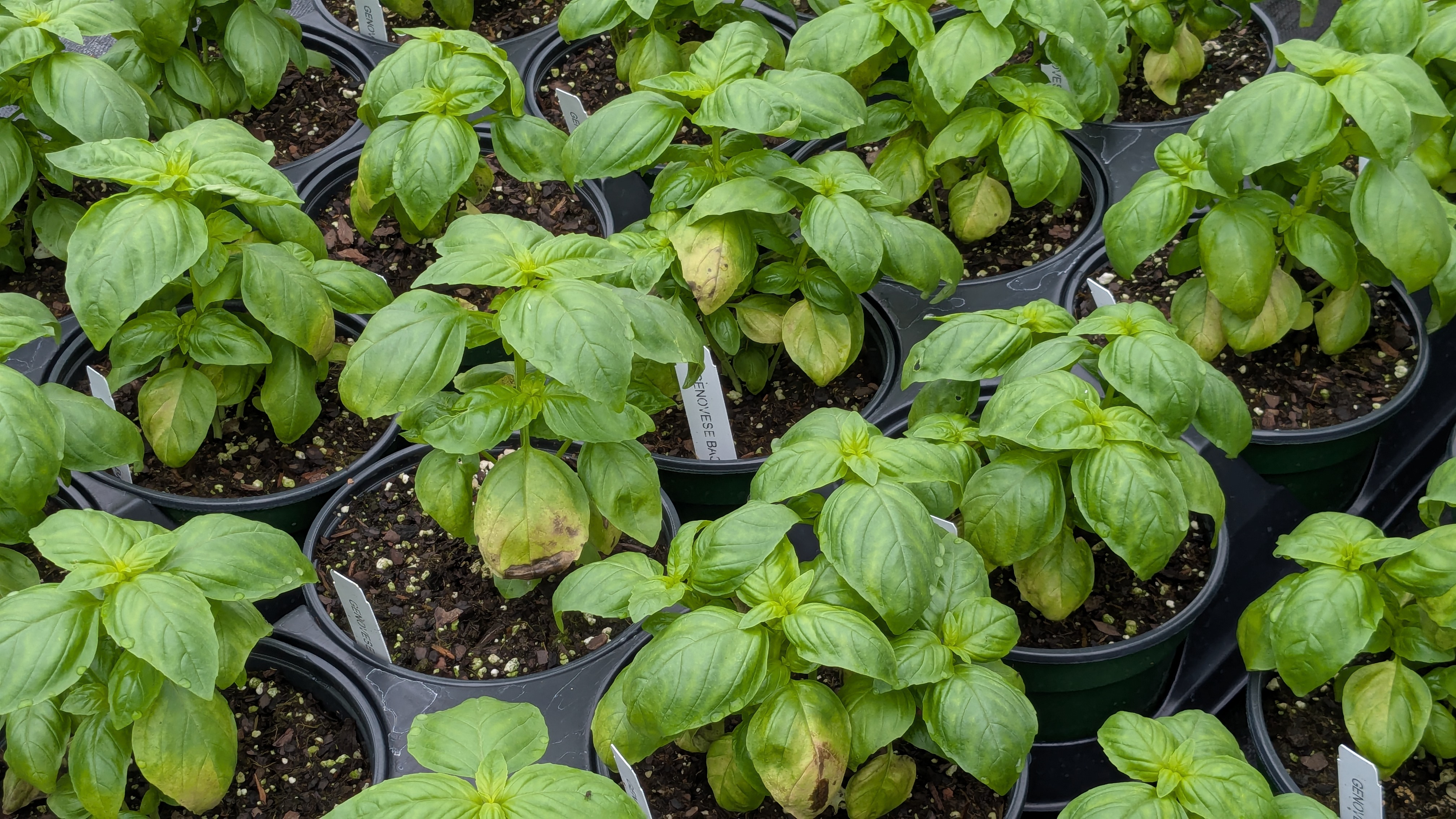
During greenhouse observations, it was once again reinforced that the importance of growing downy mildew-resistant cultivars. For retail sales, some growers prefer the cultivar ‘Everleaf’. It has a very compact growth habit and offers intermediate Fusarium resistance, but does not have downy mildew resistance. Consequently, we have observed downy mildew totally devastate a non-resistant Genovese-type crop. It went from being marketable to a loss in less than a week.
We have grown ‘Prospera Compact’ and it is downy mildew resistant, but the growth can have extensive internodal stretch. A new cultivar, ‘Lihi Prospera’ is advertised as being compact and with enhanced downy mildew resistance compared to ‘Prospera Compact’. PanAmerican Seed also has a new ‘Monteverde’ downy mildew-resistant cultivar. (These comments are based on company literature, as we have not trialed either ‘Lihi Prospera’ or ‘Monteverde’ in our research program at North Carolina State University.)
Downy mildew on basil will always be a risk. For retail sales during the fall season, when downy mildew disease pressure is greatest, are only resistant cultivars preferred? Would susceptible cultivars such as ‘Everleaf’ with superior compactness be better for only spring production? Growers will need to evaluate their disease pressure and decide on the acceptable level of risk they are willing to take.
Brian Whipker
Professor, Horticulture, North Carolina State UniversityBrian E. Whipker is a professor of floriculture at North Carolina State University. He has an appointment split between extension and research, but also teaches the graduate level plant nutrition course at NC State. His specialization is plant nutrition, plant growth regulators, and problem diagnostics. He brings over 30 year of experience in diagnosing grower plant problems.
